
Key Takeaways
- Logs aren’t detection. Platform-default logs that nobody reviews for agent behavior leave a team effectively blind.
- Attribution has three parts. Each action should name the principal that invoked the agent, the agent’s own identity, and the credential it executed under.
- Verify posture at runtime. Mature programs check what is actually in effect, not what configuration declares.
- Response has to be built in. Agent incident response belongs in the security operations center (SOC), with containment actions ready to use.
If an agent went rogue last week, would you know? At Level 1 of the Homegrown Agent Maturity Model for Execution & Risk (HAMMER), the honest answer is no. There’s no agent-specific monitoring, any fragmented system logs aren’t actionable for security purposes, and there’s no formal incident response plan. In other words, AI agent monitoring hasn’t started.
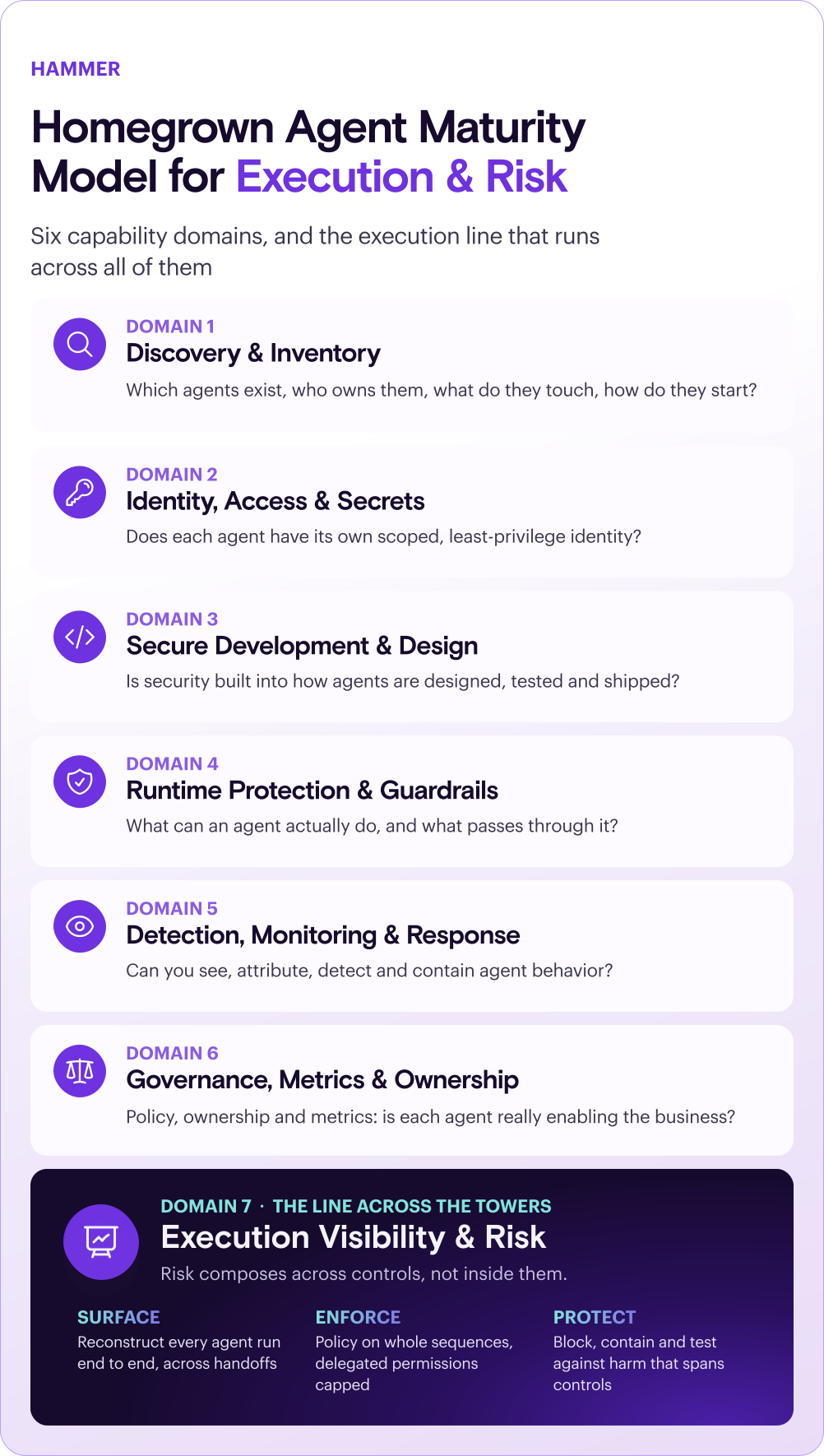
Domain 5, Detection, Monitoring, & Response, asks four things of a program: can you see what agents do, attribute it, detect harmful behavior, and respond?
Plenty of organizations have logs, and logs are a start. But a log nobody reads for agent behavior is a record, not a detection capability, and the difference becomes obvious the first time someone has to reconstruct an incident.
Seeing Is Not the Same as Knowing
Level 2 is the most common stopping point. Some platform-default logs are collected, but they aren’t analyzed for agent behavior. Incidents are found late and handled ad hoc. The logs exist somewhere, and no one is watching them.
This is a close cousin of the rogue agent element in the OWASP Top 10 for Agentic Applications. An agent operating outside its intended behavior only becomes a problem you can manage once someone is positioned to notice, and noticing requires more than a log file.
Three Parties, One Action
Level 3 is where monitoring becomes security monitoring. Prompts, tool calls, and data access are logged centrally, typically into a security information and event management (SIEM) platform, with basic alerts. An incident response playbook exists for agents. The defining feature, though, is attribution to all three parties involved. Each logged action names:
- The principal that invoked the agent
- The agent’s own identity
- The credential the action actually executed under
Consider an employee who asks an agent to pull a customer list. The agent runs the query using a service credential. A log that records only “service account ran query” can’t say who asked, which agent acted, or whether the request was legitimate. A log that records all three can, and the difference decides how quickly an investigation concludes. This is also why identity for every agent is a prerequisite for good detection: you can’t attribute an action to an identity that doesn’t exist or is shared between agents.
By Level 4, the requirement tightens. Any action can be traced back to what invoked it, so an agent’s activity is never indistinguishable from its user’s. In the case of autonomous agents, an agent's activity is never indistinguishable from the trigger that activated it.
Behavioral Detection and Verified Posture
Level 4 shifts from rule-based alerts to behavioral ones. Detection works on agent intent and actions, with anomaly detection, triaged alerts, and tracked detection metrics. Agent incident response is integrated into the SOC, so an anomalous action pages a responder who can contain it by disabling the agent or revoking its credentials.
Two additions at this level reflect a hard lesson about agents. First, changes to an agent’s own security configuration are monitored as security events. Second, enforcement posture is verified against what is actually in effect at runtime, not against declared configuration. A file that says isolation is on proves little if the agent can rewrite the file, a problem examined in more depth in the execution visibility post in this series.
Response at Agent Speed
At Level 5, observability spans the whole execution path, not just logs and configuration. It’s intent-based, and telemetry is correlated across build, runtime, and governance. Detection logic refines itself from new threat intelligence, and response is automated and self-healing.
The goal is containment before an analyst is paged. Detection after exfiltration is not security, and an agent can act far faster than a human can read an alert. That’s the thinking behind AI detection and response (AIDR) as a discipline: runtime detection and containment built around agent behavior rather than endpoint or network events.
Measure Your Detection Maturity
A quick self-test captures most of the domain: pick an agent action from last week and try to name the user, the agent, and the credential, then try to say who would have been alerted had it been harmful. Wherever that exercise stalls is where your next level begins.
Download the HAMMER eBook to see all five levels of Detection, Monitoring, & Response and benchmark your own program.
All ArticlesRelated blog posts

Isolation or Inspection? Homegrown AI Agents Need Both
AI agent runtime protection often means one thing in practice: a filter that checks prompts and responses. It’s...

Vibe-Coded Agents Inherit Their Templates’ Blind Spots
Secure AI agent development is the area where the homegrown, code-first distinction matters most. When an organization...

Every AI Agent Needs Its Own Identity, Not a Borrowed One
AI agent identity is where good intentions most often meet shortcuts. A developer needs an agent to reach a database,...
Secure Your Agents
We’d love to chat with you about how your team can secure and govern AI Agents everywhere.
Get a Demo