

OpenClaw exposes a fundamental misalignment between how traditional enterprise security is designed and how AI agents actually operate. As an AI agent assistant, OpenClaw operates with human permissions, executes actions autonomously, and processes untrusted content as input, all while sitting outside the visibility of conventional security tools. For CISOs, this creates a challenging reality: OpenClaw and similar agent assistants are increasingly being adopted across enterprises, often faster than security policies and controls can adapt.
Accountability and Incident Prevention
OpenClaw themselves acknowledge this reality. In their recently published security program, they state, “AI agents represent a fundamental shift. Unlike traditional software that does exactly what code tells it to do, AI agents interpret natural language and make decisions about actions. They blur the boundary between user intent and machine execution.” This is not about hallucinations or content quality. It’s about autonomous systems making decisions and executing actions with real enterprise impact.
The risks they document including prompt injection, indirect prompt injection, tool abuse, and identity risks, aren't theoretical. They're attack patterns affecting all AI agent systems. And critically, these are risks that traditional security models weren't designed to address.
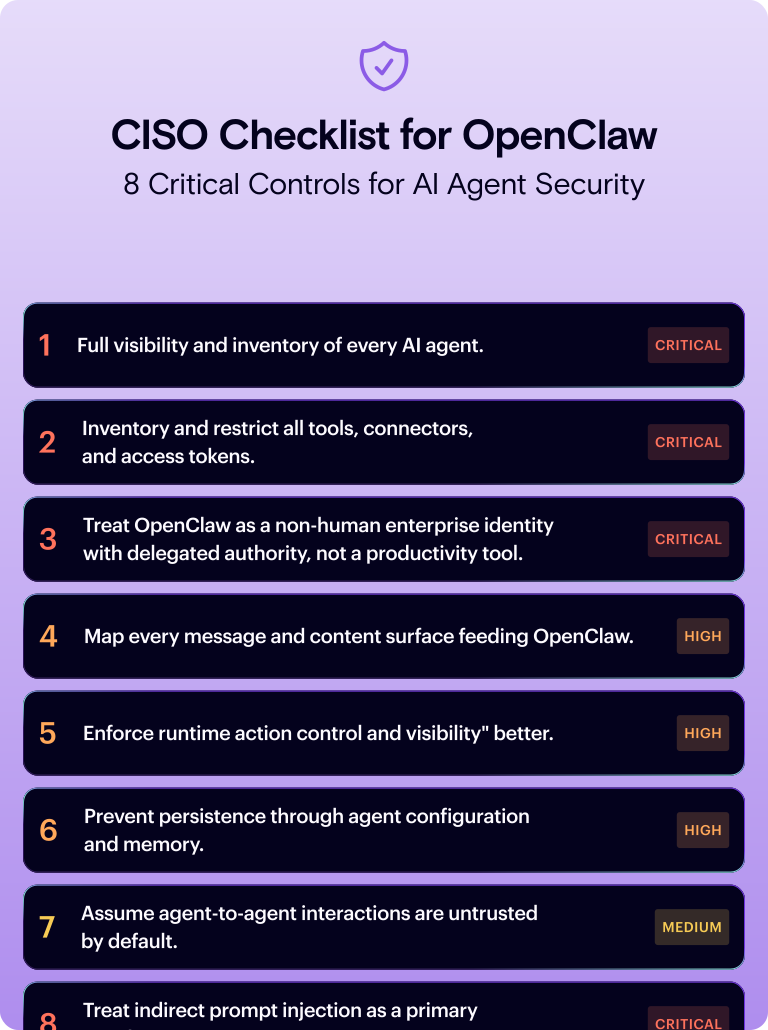
This security checklist outlines eight critical controls that form the foundation for AI agent security. It’s designed to enable fast, safe adoption of emerging agent ecosystems, including OpenClaw. Each item addresses a specific gap between how agents operate and how enterprise security assumes they work.
1. Full visibility and inventory of every AI agent
CRITICAL Severity: You cannot secure what you cannot see. Unknown deployments bypass all controls.
Agent adoption outpaces policy enforcement. Security teams often discover agents after misuse occurs.
What to do
- Scan endpoints and servers for OpenClaw gateways.
- Identify installs tied to corporate identities on personal devices.
- Require centralized registration of all agents.
- Block new installs outside approved paths.
Industry signal: The CIS Critical Security Controls identify asset inventory as the foundation for all other controls. Automation without inventory consistently precedes incidents.https://www.cisecurity.org/controls/inventory-and-control-of-enterprise-assets
Zenity guidance: Zenity analysis shows OpenClaw operating outside centralized security controls while maintaining access to enterprise systems.https://zenity.io/resources/new-agent-ecosystems/openclaw-security
2. Inventory and restrict all tools, connectors, and access tokens.
CRITICAL Severity: Tool access defines blast radius. Over-permissioned tokens enable wide-scale damage.
Tool access defines blast radius. When agents chain integrations, impact scales fast. Over permissioned connectors turn minor failures into enterprise incidents.
What to do
- Enumerate every connected tool and API.
- Reduce scopes to task specific access.
- Default connectors to read access.
- Audit and rotate tokens on a fixed cadence.
Industry signal: NIST SP 800-53 Access Control guidance requires least privilege for automated access and delegated authority.https://csf.tools/reference/nist-sp-800-53/r5/ac/ac-6/
Zenity guidance: Zenity Labs shows how token misuse and tool chaining amplify agent impact.https://labs.zenity.io/p/i-just-wanted-to-take-a-note-and-your-token-came-along-c615
3. Treat OpenClaw as a non-human enterprise identity with delegated authority, not a productivity tool.
CRITICAL Severity: Without identity classification, all other controls fail. This is the foundation.
OpenClaw performs actions using human permissions across systems. When these actions cause data exposure or operational damage, accountability remains with security leadership. Treating OpenClaw as a helper instead of an identity creates unmanaged risk.
What to do
- Classify OpenClaw as a non human identity.
- Assign a business owner and a security owner.
- Document all actions and systems tied to the agent.
- Apply identity lifecycle controls equal to service accounts.
Industry signal: NIST Zero Trust Architecture defines security ownership at the action level rather than trusting sessions or tools. This model applies directly to autonomous execution.https://nvlpubs.nist.gov/nistpubs/specialpublications/NIST.SP.800-207.pdf
Zenity guidance: Zenity Labs documents OpenClaw executing commands and chaining tools using inherited user permissions.https://labs.zenity.io/p/clawdbot-more-than-you-bargained-for
4. Map every message and content surface feeding OpenClaw.
HIGH Severity: Input surfaces are attack vectors, but impact depends on tool permissions.
OpenClaw converts inbound content into execution. Messages function as execution triggers. Any untrusted channel becomes an execution surface bypassing traditional security inspection layers.
What to do
- List all connected chat, email, browser, and social inputs.
- Classify trusted versus untrusted sources.
- Disable execution from high risk channels.
- Log which inputs trigger actions.
Industry signal: OWASP identifies prompt injection and content-driven manipulation as top risks for LLM-based systems.https://owasp.org/www-project-top-10-for-large-language-model-applications/
Zenity guidance: Zenity Labs demonstrates data structure and content injection leading directly to agent actions.https://labs.zenity.io/p/data-structure-injection-dsi-in-ai-agents
5. Enforce Runtime Visibility
HIGH Severity: Prevents harmful execution, but requires items 1-4 to be effective first.
Configuration compliance without runtime enforcement fails when tested by real-world conditions. Risk appears at runtime when authorized agents perform harmful sequences. Compliance without enforcement fails under real conditions.
What to do
- Define approved actions per tool.
- Block destructive actions by default.
- Require approval for high impact operations.
- Inspect parameters, not only tool names.
Industry signal: Zero Trust guidance emphasizes continuous verification of actions rather than static authorization.https://nvlpubs.nist.gov/nistpubs/specialpublications/NIST.SP.800-207.pdf
Zenity guidance: The OpenClaw security webinar outlines runtime visibility and control for agent assistants.https://zenity.io/resources/webinars/openclaw-how-to-secure-agent-assistants
6. Prevent persistence through agent configuration and memory.
HIGH Severity: Turns single incidents into long-term compromise, but requires initial access first.
Persistence turns a one time interaction into long term control. OpenClaw allows durable changes without code modification. Traditional endpoint controls fail to detect this as malware, creating a blind spot in security operations.
What to do
- Monitor changes to agent configuration and memory files.
- Restrict who and what can modify persistent state.
- Alert on new integrations or listeners created by agents.
- Review persistence changes during incident response.
Industry signal: MITRE ATT&CK defines persistence as a core post-compromise objective regardless of exploit method.https://attack.mitre.org/tactics/TA0003/
Zenity guidance: Zenity Labs documents durable agent persistence through tool-driven state manipulation.https://labs.zenity.io/p/tools-of-the-trade
7. Assume agent-to-agent interactions are untrusted by default
MEDIUM Severity: Important for organizations in multi-agent environments, but narrower scope than other items.
Agents ingest content produced by other agents. Malicious agents target this behavior. Trust collapses when agents amplify each other without validation.
What to do
- Inventory agent interaction surfaces,
- Define trust boundaries for agent-generated content.
- Restrict ingestion from unverified sources.
- Monitor for coordinated or anomalous agent activity
Industry signal: MITRE ATLAS tracks adversarial techniques targeting AI systems and automated decision flows.https://atlas.mitre.org/
Zenity guidance: Zenity Labs observed active agent-to-agent exploitation on Moltbook built on OpenClaw.https://labs.zenity.io/p/agent-to-agent-exploitation-in-the-wild-observed-attacks-on-moltbook-b929
8. Treat indirect prompt injection as a primary initial access vector.
CRITICAL Severity: This is the primary exploit path. No traditional perimeter defense applies.
OpenClaw processes untrusted content and turns it into actions. No exploit is required. This bypasses perimeter controls, malware detection, and traditional IAM safeguards. Security ownership still applies. OpenClaw explicitly identifies this risk, “Malicious content in fetched URLs, emails, or documents can hijack agent behavior.” This isn't a vulnerability in OpenClaw. This is architectural in how agents process untrusted content.
What to do
- Identify all untrusted content sources.
- Prevent untrusted content from triggering execution.
- Monitor configuration and behavior changes driven by content.
- Flag content driven actions as security events.
Industry signal: OWASP GenAI guidance classifies prompt injection as a primary risk for agent systems.https://genai.owasp.org/llmrisk/llm01-prompt-injection/
Zenity guidance: Zenity Labs shows indirect prompt injection leading to persistent backdoors in OpenClaw.https://labs.zenity.io/p/openclaw-or-opendoor-indirect-prompt-injection-makes-openclaw-vulnerable-to-backdoors-and-much-more
Agent assistants like OpenClaw are not a future concern, they are a present reality that requires immediate security ownership. The controls outlined in this checklist address the foundational gaps that turn helpful automation into organizational risk. Agent security cannot be solved by extending existing controls alone. It requires visibility and enforcement inside the agent execution loop - where intent, data, and action converge. Waiting for agents to fit existing security models means responding to incidents instead of preventing them. Start with visibility, establish ownership, and build enforcement before the next deployment. Your security program's effectiveness depends on recognizing that agents are identities, not just tools.
All ArticlesRelated blog posts

How Zenity Implements the 2026 OWASP Top 10 for LLM Applications
Every AI security framework names the risks you have to control. Zenity is built to implement those controls at...

Secure AI Agents, Everywhere: Why Prompt Injection Is Only Part of the Problem
The rules have changed. In every AI deployment, the agent itself is now part of the threat model, and that's a...

Coalition Chaos
I've tracked eighteen initiatives across a dozen countries, five months, and several issues being worked seven...
Secure Your Agents
We’d love to chat with you about how your team can secure and govern AI Agents everywhere.
Get a Demo